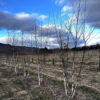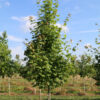

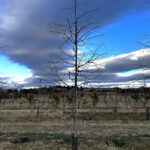
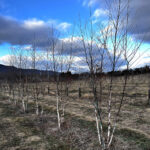
Acer saccharum, commonly known as sugar or rock maple, is a large, deciduous, climax-forest tree, usually growing 80 to 115 ft / 25-35m (occasionally 150 ft / 45m) tall in the wild. It is native from the Canadian Maritimes and southern Ontario south through the Appalachians to Tennessee and west to the upper Mississippi valley. In northern reaches of its native range and at higher elevations, it often forms nearly pure stands, often in association with spruces (Picea), firs (Abies), beech (Fagus), basswood (Tilia), and birch (Betula). It is one of the longest-lived plants of eastern North America, with numerous specimens recorded as reaching 350-400 years of age. In the wild, it frequently forms species complexes with black maple (A. nigrum) with hybridized forms intermediate in character to the two species often found.
A. saccharum is a moderately fast grower; upright-oval in habit in youth, becoming wide-spreading and rounded with age. Older trees in forested areas often lose most of their lower branches resulting in a ragged dome-like crown. The palmate, coarsely toothed, opposite leaves are medium green in color with five lobes and typically range from 4 to 6 inches (10-15 cm) across. The fall color is usually spectacular, ranging from clear yellow in poorer autumns to fiery shades of crimson, scarlet, and orange under the best conditions. Small greenish-yellow flowers are followed by green samaras (‘helicopters’), which turn tan and drop in autumn. The bark is smooth and pale grey in youth becoming furrowed and deep grey-brown with age.
(Post continues below photos.)
Sugar maple is tolerant of a variety of soil types from clay to loam to sand, but performs best in rich, loamy soil. It is highly intolerant of pollution, salts, and poor drainage, but is one of the few native trees that can survive as an understory plant and in the root zone of black walnut (Juglans nigra). While the root system is deeper than most Acer species, it also tends to have an extensive network of fine surface roots, which when combined with the deep shade cast by a mature tree limits the viability of understory plants. The multi-level root system serves as a hydraulic lift, transporting deeper groundwater to the surface for its own benefit and that of surrounding plants. A. saccharum can be susceptible to diseases and pests such verticillium wilt, tar spot, anthracnose, borers and cottony maple scale but is usually not strongly affected unless the tree is suffering from severe prior stress.
Economically, sugar maple and black maple (A. nigrum), are the source of the multi-billion dollar maple syrup and sugar industry. Effective harvesting of sap for syrup-making requires a long cold-dormancy period, so the most productive tracts for sap harvesting are generally located north of the 42° or 43° parallel. The wood of A. saccharum has an attractive grain and is very durable and is extensively used for a variety of purposes, including flooring, furniture, stringed musical instruments, pool cues, and bowling pins. Due to the demise of most Fraxinus in North America due to the emerald ash borer, it is now the primary wood used for the construction of baseball bats.
In the landscape, A. saccharum is best used as a specimen or shade tree in a larger space. Under these conditions, it typically tops out at 70-80 feet or 22-25 meters. White House Natives inventory of Acer saccharum for spring 2026 ranges from 1¼” to 1¾” caliper. If you have the space, it is truly a magnificent year-round addition to the landscape.